

The Ultimate Guide to Rough Terrain Forklifts
- Release time: Jul 23, 2026
- Author: admin
- Views: 119
- Column: Products Knowledge
What Is a Rough Terrain Forklift?
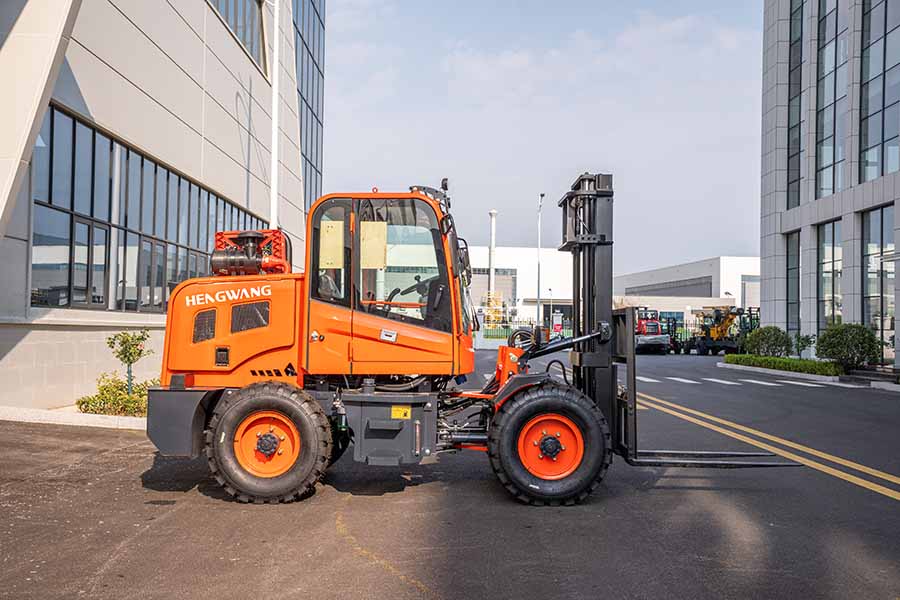
A Rough Terrain Forklift (RT Forklift) is an industrial handling machine specifically designed for unpaved roads, muddy construction sites, sandy terrain, gravel slopes, and other challenging environments. Unlike conventional forklifts that operate only on flat concrete surfaces, rough terrain forklifts are equipped with large-diameter deep-tread pneumatic tires, heavy-duty chassis, and four-wheel drive (4x4) systems, enabling stable loading, stacking, and short-distance transport under tough conditions.
Core Off-Road Performance Features
1. 4x4 Drive with Differential Locks
Rough terrain forklifts come standard with four-wheel drive systems, and some high-end models are equipped with front and rear axle differential locks. When one side of the wheels slips in mud or sand, the differential lock transfers 100% of the power to the wheels with traction, preventing the vehicle from getting stuck. This design gives rough terrain forklifts far superior passability over wet slopes, soft soil, and waterlogged surfaces compared to standard forklifts.
2. Ground Clearance & Approach/Departure Angles
Rough terrain forklifts feature a minimum ground clearance of over 300mm, combined with optimized approach and departure angles (typically ≥30°), allowing them to easily cross rocks, tree roots, trenches, and construction debris. The high-position air intake and exhaust system also effectively prevents engine water ingress during wading, further expanding operational scenarios.
3. All-Terrain Tires & Suspension Systems
Rough terrain forklifts use large low-pressure pneumatic tires with deep, wide tread patterns for powerful grip. Paired with heavy-duty rigid axles or independent suspension systems, they effectively absorb ground impact, protecting both the load and operator. Even on gravel, hard-packed soil, or snow, they maintain excellent stability and maneuverability.
4. Powerful Engine & Gradeability
Rough terrain forklifts are typically powered by turbocharged diesel engines ranging from 50HP to 150HP, delivering abundant low-speed high-torque output. With a gradeability of 35%–45% (approximately 19°–24°) at full load, they easily handle slope operations in open-pit mines, forestry, and construction sites.
5. Full-Vision Cab & Control System
The cab of a rough terrain forklift is designed with an emphasis on broad visibility, with optimized mast and fork positioning, allowing operators to clearly observe surroundings in complex terrains. The hydraulic steering system is light and responsive, with multi-speed control functions, enabling precise handling in tight spaces and improving operational efficiency and safety.
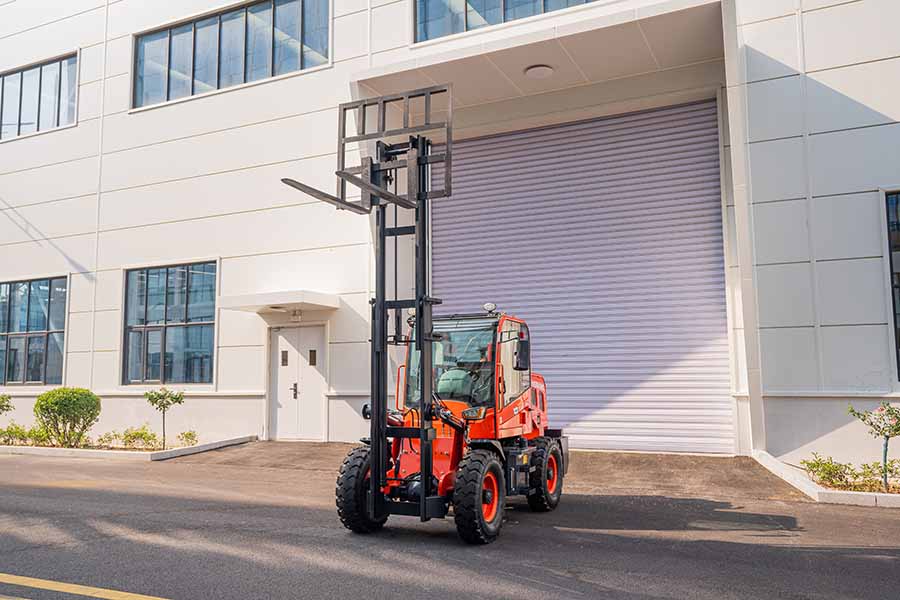
Rough Terrain vs. Standard Forklift: Key Differences
| Feature | Rough Terrain Forklift | Standard Forklift (Indoor/Warehouse) |
|---|---|---|
| Surface | Mud, sand, gravel, slopes, snow | Smooth concrete / epoxy floors |
| Drive | 4x4 four-wheel drive | Rear-wheel drive (2WD) |
| Tires | Deep-tread pneumatic tires | Solid or smooth tires |
| Ground Clearance | ≥300mm | ≤150mm |
| Gradeability | 35%–45% | ≤15% |
| Engine | High-torque diesel | Diesel / Gasoline / Electric |
| Applications | Mines, farms, forestry, ports, construction sites | Warehouses, logistics centers, factory floors |
Key Application Industries
Rough terrain forklifts are widely used in the following industries:
Construction Sites – Loading and moving rebar, precast concrete, bricks, and formwork.
Open-Pit Mines – Stockpiling and short-distance transport of ore, coal, and aggregates.
Agriculture & Forestry – Efficient handling of hay bales, fertilizers, timber, and irrigation equipment.
Ports & Yards – Off-road transfer of containers, bulk cargo, and heavy pipes.
Oil & Gas – Equipment transport for pipeline laying and drilling sites.
How to Choose the Right Rough Terrain Forklift?
When selecting a rough terrain forklift, consider the following five factors:
Rated Capacity – Choose from 1.5 to 10 tons based on typical load weight, with a 10%–15% margin recommended.
Lift Height – Standard mast height is 3m, with optional 4.5m or 6m masts available.
Engine Power – Select appropriate power based on altitude and slope; turbocharged models are recommended for high-altitude sites.
Attachment Options – Choose forks, buckets, lifting hooks, side shifters, etc., to suit multiple tasks.
After-Sales Service – Prioritize brands with local parts inventory and technical support.
Maintenance Tips for Rough Terrain Forklifts
To extend the service life of your rough terrain forklift, follow this maintenance schedule:
Daily Checks – Tire pressure, oil level, coolant, lights, and brake system.
Every 250 Hours – Replace engine oil and filter.
Every 500 Hours – Replace hydraulic fluid and transmission oil; check differential oil.
Every 1,000 Hours – Full inspection of drive axle, steering system, and brake pads.
Long-Term Storage – Clean the chassis, apply anti-rust agent, disconnect battery negative terminal, and store in a dry, ventilated area.
Frequently Asked Questions
Q1:Can rough terrain forklifts operate in snow?
Yes. With deep-tread tires and optional snow chains, rough terrain forklifts can operate safely on snow-covered surfaces.
Q2:What is the difference between a rough terrain forklift and a telehandler? Rough terrain forklifts have vertical lifting and are ideal for short-distance handling. Telehandlers have a telescopic boom for forward reach and elevated placement, suitable for wider-span operations.
Q3:Can rough terrain forklifts be licensed for road use?
Depending on local regulations. Some countries allow short-distance low-speed road travel with warning lights and reflective markings, but trailer transport is recommended.
Keywords: rough terrain forklift,4x4 forklift,off-road forklift,all-terrain forklift,forklift price,construction equipment,mining forklift
Meta Description:
The ultimate guide to rough terrain forklifts. Learn about 4x4 forklift off-road performance, applications, maintenance, and price comparisons. Ideal for mines, farms, construction sites, and more. Get a free quote today!